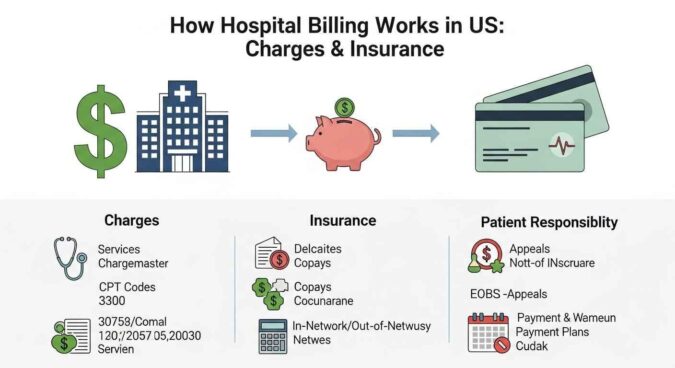
Learn how hospital billing works in the US, including charges, insurance, patient responsibility, and tips to manage bills effectively.
How Hospital Billing Works in the US Starts With the Chargemaster
The first step in understanding how hospital billing works in the US is the chargemaster, the hospital’s master price list for every service and supply. This list sets “billed” prices for room stays, lab tests, procedures, and equipment—but rarely reflects what insurance or patients actually pay.
Hospitals negotiate rates with private insurers, Medicare, and Medicaid, often lowering costs significantly. Uninsured patients may face higher bills, though many hospitals offer financial assistance policies or charity care.
Each service must also be coded correctly using CPT codes hospital and ICD-10 diagnosis codes, with contractual adjustments applied. Errors here can cause overcharges or delays, complicating how hospital billing works in the US.
Requesting an itemized hospital bill and comparing it with your Explanation of Benefits (EOB) helps catch mistakes. Understanding the chargemaster is the first step to managing bills and taking control of your healthcare expenses.
Medical Coding and How Hospital Billing Works in the US Behind the Scenes
Medical coding is key to understanding how hospital billing works in the US. Every procedure, diagnosis, and service is translated into CPT codes hospital and ICD-10 diagnosis codes so the hospital can submit a claim to insurers. Mistakes here can cause delayed payments, claim denials, or inflated bills.
Hospitals use revenue cycle management (RCM) systems to track each step, from admission to final payment. After coding, the insurance claim enters adjudication, where the insurer checks coverage, in-network status, and prior authorization. This process directly affects how much the hospital is paid and what the patient owes. By mastering how coding affects charges, claims, and insurance processing, you gain a clearer picture of how hospital billing works in the US, reduce errors, and can advocate for correct billing. This knowledge is essential for anyone navigating complex bills or multiple healthcare providers.
Insurance Adjudication: How Hospital Billing Works in the US With Private Insurance, Medicare, and Medicaid
Insurance adjudication is a critical step in understanding how hospital billing works in the US. After a hospital submits a claim, the insurer reviews it to determine payment, patient responsibility, and any necessary adjustments.
Coverage is verified, in-network status is checked, and prior authorization requirements are confirmed. The allowed amount insurance pays often differs from chargemaster rates, and contractual adjustments are applied, explaining why bills may not match insurer payments.
Medicare, Medicaid, and private insurers follow different reimbursement rules, which can result in multiple bills for a single visit. Coding or coverage errors can also inflate costs.
Reviewing your Explanation of Benefits (EOB) alongside the itemized hospital bill helps spot discrepancies. Understanding insurance adjudication allows patients to avoid overpayment and better manage out-of-pocket costs while seeing how hospital billing works in the US.
| Topic | Details |
|---|---|
| Section | Insurance Adjudication: How Hospital Billing Works in the US with Private Insurance, Medicare, and Medicaid |
| Definition | A process where the insurer reviews submitted claims to determine payment, patient responsibility, and adjustments. |
| Key Steps | – Verify coverage- Check in-network status- Confirm prior authorization requirements |
| Allowed Amount vs Chargemaster | The insurer’s allowed amount often differs from chargemaster rates; contractual adjustments are applied. |
| Multiple Bills | Medicare, Medicaid, and private insurers follow different rules; a single Different departments may issue separate bills for the same visit. |
| Common Errors | Coding mistakes or coverage errors can inflate bills. |
| Patient Action | Review Explanation of Benefits (EOB) alongside itemized hospital bill to spot discrepancies. |
| Benefit | Helps avoid overpayment and manage out-of-pocket costs; clarifies how hospital billing works in the US. |
Patient Responsibility and How Hospital Billing Works in the US After Insurance Pays
Patient responsibility is the stage where you truly see how hospital billing works in the US. After insurance adjudication, you are responsible for costs not covered, including deductibles, copays, coinsurance, and sometimes out-of-network charges.
Bills often separate facility fees, physician charges, labs, or imaging, which can result in multiple statements for one visit. The allowed amount insurance pays is subtracted from chargemaster rates, leaving the remainder as your responsibility.
Reviewing your itemized hospital bill alongside your Explanation of Benefits (EOB) helps spot coding errors, misapplied discounts, or incorrect charges. Understanding this step is key to avoiding overpayment and fully grasping how hospital billing works in the US.
Many hospitals offer financial assistance policies or charity care, and laws like the No Surprises Act protect against unexpected charges. Careful review allows you to manage costs and dispute errors effectively.
Understanding Your Bill: How Hospital Billing Works in the US on Paper
Reading and understanding your hospital bill is essential to knowing how hospital billing works in the US. Hospitals provide an itemized hospital bill detailing each service, procedure, supply, and charge. Comparing it with your Explanation of Benefits (EOB) helps identify coding errors, overcharges, or discrepancies.
Charges are linked to CPT codes hospital, ICD-10 diagnosis codes, and chargemaster rates. Missing contractual adjustments or coding mistakes can inflate bills, making it difficult to see your actual patient responsibility. Departments like labs, imaging, and physicians may bill separately, resulting in multiple statements for one visit.
Understanding allowed amount insurance versus billed charges clarifies why payments differ. Reviewing bills carefully allows you to dispute errors, request explanations, and apply financial assistance policies.
Legal Protections That Affect How Hospital Billing Works in the US
Legal protections help patients understand and manage how hospital billing works in the US. The No Surprises Act prevents unexpected out-of-network charges and stops balance billing when provider choice is limited.
Nonprofit hospitals must offer financial assistance policies or charity care to help uninsured or low-income patients reduce costs. Knowing these options is vital for managing patient responsibility effectively.
Programs like Medicare and Medicaid enforce billing rules, including proper coding, claim submission, and contractual adjustments, ensuring fairness and transparency in how hospital billing works in the US.
Understanding your rights and protections lets you prevent overcharges, dispute errors, and navigate hospital bills confidently. Awareness of laws, assistance programs, and insurance requirements gives patients control over an often complex process.
Tips to Reduce Your Hospital Bill
Knowing practical strategies can help you reduce costs and better understand how hospital billing works in the US. One of the first steps is to request an itemized hospital bill and compare it to your Explanation of Benefits (EOB). This helps spot duplicate charges, errors in CPT codes hospital, or misapplied ICD-10 diagnosis codes.
Ask the hospital about financial assistance policies or charity care programs if you are uninsured or face high patient responsibility. Many hospitals also offer payment plans that can make bills manageable without accruing interest or penalties.
Checking whether services were provided in-network and understanding allowed amount insurance before you pay can prevent balance billing surprises. If errors are found, contacting the billing department or using a medical billing advocate can save substantial money.
FAQ – How Hospital Billing Works in the US
What causes multiple hospital bills for a single visit?
Multiple bills happen because hospital billing separates facility, physician, lab, and imaging charges. Each department may bill independently, which is why understanding how hospital billing works in the US helps you track and reconcile these charges.
Why is my hospital bill higher than my Explanation of Benefits (EOB)?
Your bill may be higher because the hospital lists full chargemaster rates while the EOB shows the insurer’s allowed amount. This difference is central to understanding how hospital billing works in the US and why your patient responsibility may differ from the billed amount.
Can I request adjustments or reductions on my hospital charges?
Yes, many hospitals allow negotiation or payment plans, especially if you qualify for financial assistance. Knowing how hospital billing works in the US gives you the leverage to question inflated charges or request adjustments.
