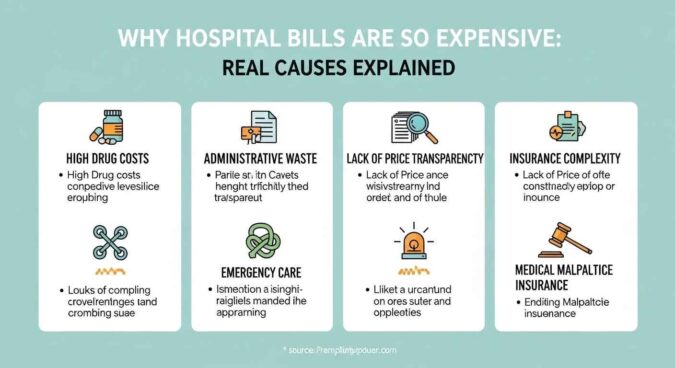
Discover the real reasons why hospital bills are so expensive, from pricing, insurance, and admin costs to tech, drugs, and market factors.
Why Hospital Bills Are So Expensive: The Broken Pricing System
One of the main reasons why hospital bills are so expensive is how hospitals set their prices. Most use a chargemaster with prices that rarely reflect actual costs—an MRI can cost $1,200 at one hospital and $3,000 at another.
Regional differences and limited competition push prices higher, while administrative costs like billing staff and coding are added to bills. Insurance negotiations also play a role: hospitals inflate list prices knowing insurers will discount, but patients may still pay large balances.
Why Hospital Bills Are So Expensive Due to Administrative Costs
Administrative complexity is another major reason why hospital bills are so expensive. Behind every bill is a network of staff, coders, and billing systems that add costs rarely benefiting patients.
Processing thousands of insurance claims, handling upcoding, and managing claim denials all drive bills higher. Medical billing costs and administrative overhead explain why hospital bills are so expensive beyond the actual care delivered.
Even routine procedures can carry high costs because of these hidden factors. Understanding this system is key to seeing why hospital bills are so expensive and why transparency reforms could reduce patient expenses.
Why Hospital Bills Are So Expensive Because of Insurance Negotiations
Insurance negotiations are a key reason why hospital bills are so expensive. Hospitals rarely charge patients the full listed price. Instead, they negotiate rates with insurance companies, creating a system where insured patients may get discounts, but uninsured or underinsured patients often pay much more.
Administrative work tied to insurance claims—tracking payments, managing denials, and handling appeals—adds another hidden layer of cost. Surprise billing, such as charges from out-of-network providers, further increases patient bills and confusion.
Understanding insurance negotiations helps explain why hospital bills are so expensive and highlights the importance of checking coverage, negotiating bills, and reviewing charges carefully.
| Factor | Explanation | Effect on Patient Charges |
|---|---|---|
| Insurance Negotiations | Hospitals negotiate rates with insurers instead of charging the full list price. | Insured patients may get discounts, but uninsured/underinsured patients pay more, contributing to why hospital bills are so expensive. |
| Administrative Work | Tracking payments, managing claim denials, and handling appeals. | Adds hidden costs to patient bills. |
| Surprise Billing | Charges from out-of-network providers. | Increases patient confusion and unexpected expenses, further explaining why hospital bills are so expensive. |
| Overall Impact | Combined effect of negotiation, admin overhead, and surprise billing. | Explains a major portion of why hospital bills are so expensive and emphasizes checking coverage and reviewing bills. |
Why Hospital Bills Are So Expensive After Hospital Mergers
Hospital mergers and market consolidation are major reasons why hospital bills are so expensive. When hospitals combine into large networks, competition decreases, giving these systems the power to set higher prices. Even routine procedures can cost significantly more in consolidated markets.
Facility fees are another hidden cost. Many hospitals charge extra simply for the use of their facilities, which contributes to why hospital bills are so expensive. This practice affects both insured and uninsured patients and often comes as a surprise on the final bill.
Understanding hospital consolidation explains why hospital bills are so expensive and highlights the systemic market pressures that keep healthcare costs elevated. Awareness of this factor can help patients research pricing options and make more informed choices when selecting care providers.
Why Hospital Bills Are So Expensive Due to Technology and Drug Costs
High technology and drug costs are key reasons why hospital bills are so expensive. Hospitals invest in MRI and CT scanners, surgical robots, and emergency infrastructure, and these capital costs are passed on to patients.
Pharmaceuticals and marked-up medical supplies also add to bills, explaining why hospital bills are so expensive even for routine procedures.
Understanding technology and drug costs helps explain why hospital bills are so expensive and encourages patients to ask questions, compare providers, and explore lower-cost options.
Why Hospital Bills Are So Expensive for Emergency Visits
Emergency visits are a major factor in why hospital bills are so expensive. Emergency rooms must be ready 24/7, which requires specialized staff, advanced equipment, and rapid access to care. This readiness comes with high operating costs that are reflected in patient bills.
Uninsured or underinsured patients often face the full list price, while cost-shifting from these patients to insured patients inflates overall charges. Defensive medicine—ordering extra tests or procedures to avoid liability—adds another layer of expense, further explaining why hospital bills are so expensive.
Labor costs also play a role. Nurses, emergency physicians, and support staff command higher wages due to the intense, high-stakes environment, and hospitals pass these costs onto patients.
How to Reduce the Impact of Why Hospital Bills Are So Expensive
There are practical steps patients can take to reduce why hospital bills are so expensive. Start by requesting an itemized bill and checking for errors or duplicate charges.
Negotiating with hospitals, using payment plans or financial assistance, and comparing prices with transparency tools can also help.
By taking these steps, patients can lessen the impact of why hospital bills are so expensive and manage healthcare costs more effectively.
FAQ: Why Hospital Bills Are So Expensive
1. Why are hospital bills so expensive in the US?
Hospital bills are so expensive due to a combination of pricing opacity, administrative costs, insurance negotiations, and high technology and drug expenses. These factors together explain why hospital bills are so expensive even for routine procedures.
2. Why do hospital bills vary so much for the same procedure?
Price variation is a key reason why hospital bills are so expensive. Hospitals set different chargemaster prices, negotiate differently with insurers, and adjust rates based on regional market power.
3. Why are hospital bills so expensive even with insurance?
Insurance plans can unintentionally increase why hospital bills are so expensive. High deductibles, coinsurance, and out-of-pocket limits shift costs to patients, while hospitals maintain inflated list prices knowing insurers will pay.
4. How are hospital bills calculated?
Understanding billing explains why hospital bills are so expensive. Hospitals use chargemaster lists, add administrative overhead, incorporate technology and drug costs, and apply insurance-negotiated rates to determine final charges.
5. Can you negotiate a hospital bill?
Negotiation is a practical way to address why hospital bills are so expensive. Patients can request itemized bills, dispute errors, negotiate payment terms, and apply for financial assistance to reduce costs.
6. What increases hospital bills the most?
Administrative costs, high-tech equipment, drug prices, and emergency care are the main drivers of why hospital bills are so expensive. Cost-shifting and hospital consolidation also add to the total charges.
